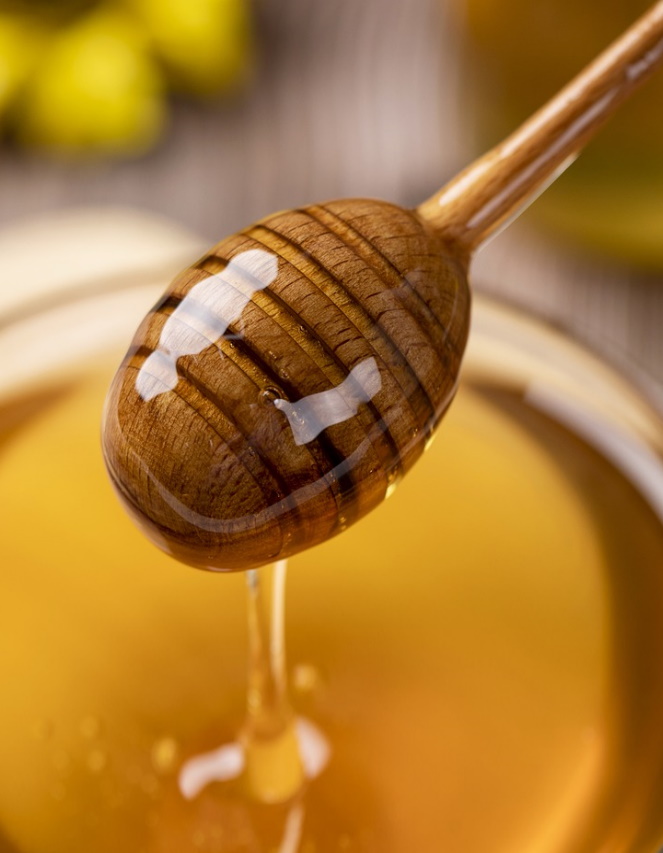
Wild Honey
Why Raw & Wild Honey
When choosing honey you have likely come across labels that use words like “raw,” “pure,” “organic,” and “unfiltered” – but you may be left asking what exactly the difference is.
A “pure honey” label means that you are getting 100% honey, without any other ingredients (such as corn syrup, which is sometimes added to industrial honey to reduce costs). However “pure” honey alone doesn’t always tell you much about the varietal or how the honey is produced, so it’s good to look for more information to make sure you’re getting all the benefits you can from honey when it’s produced by bees in an environment friendly way.
The difference between raw honey and pure honey is that in addition to being pure, “raw” honey has not been heated to the point of pasteurisation (no higher than 118°F). The benefit of not heating honey is that the naturally-occurring enzymes, vitamins and minerals are preserved and you get the full benefits of them from eating raw honey. If you have the choice between raw honey vs regular honey, raw honey is a better choice for health, taste, bees and the environment.
“Filtering” honey means processing the honey to remove very small particles, often even as small as the pollen. Filtering honey is not the same as straining honey, which is commonly done to remove bee parts and other large debris prior to jarring while still retaining the pollen and other beneficial qualities of honey. With filtration, honey is also often heated to become more liquid in order to make the filtering process easier, meaning that the honey is no longer raw. Therefore, unfiltered honey is not necessarily raw unless labelled so, but it will be closer to its state straight from the hive than honey that has been filtered.
Choosing raw unfiltered honey ensures the most properties have been preserved. Raw honey contains up to 4.3 times more antioxidants than the processed variety – Many studies have linked these antioxidants with impressive health benefits as only raw honey contain beneficial pollen and all the nutrients intact.
Sustainable Harvest
We work with numerous tribal settlements in South Indian forests where collection of the Wild Raw Honey is in their culture. The harvester amongst the tribe is trained to cut out only the part of the hive which contains the honey and to leave the rest of the hive intact. The Bees are quick to rebuild the hive which helps sustain the bee population in the wild. The extraction is done in the most hygienic way to ensure our customers get the best quality raw honey.
FREQUENTLY ASKED QUESTIONS
Get answers to all your queries about products or purchases.
Has the taste of honey slightly changed compared to last purchase?
Change in taste and composition is seasonal – Nectar being an aqueous solution of sugars (carbohydrates). The concentration in nectar is not uniform and it depends on nectar-secreting plant species, climatic conditions, time of day or year, and many other factors. The first stage in the formation of nectar is the evaporation of water and transfer to the appropriate patch of cells, where chemical changes begin to occur. They occur mainly due to enzymes delivered with the saliva of worker bees. Studies have found that the percentage of sugars in nectar runs from 5% to 87%.
The honey seems to be generating foam inside the bottle?
This is the result of tiny air bubbles in the honey escaping on the top. When the package honey rests, the air bubbles work their way up to the top of the container, creating the foam. There is nothing wrong with the honey of the foam.
Does pure honey crystallise?
Honey as a natural product will eventually crystallise or solidify. Crystallisation occurs when the suspended sugars in liquid honey form natural bonds with one another. Honey is both edible and enjoyable in its crystallised form. Honey may be liquified easily by placing in a bowl of warm water.
Why are there different colours of honey?
There are several factors that affect color. The biggest one is simply nectar source. Each type of plant is unique providing nectar with different sugar contents, floral esters, aroma etc. Worker bees collect plant nectar from thousands of blooming plants. Colours vary from white to amber to dark amber. Understanding the origin helps explain the wide variety in color and taste.
Jungle Bee
#83, 4th Cross Road, 7th Block,
Koramangala, Bengaluru,
Karnataka – 560095. India.
Phone: +91 6366939221 / +91 6366939227
Email: info@junglebee.in
Please fill up the form for queries...